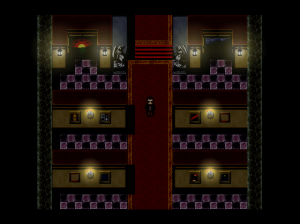
One Night Walkthrough

If there’s one thing you can always count on my email inbox to be full of, it’s SOS messages from people who are hopelessly stuck in the One Night games. With that in mind, I thought I’d do something about it and begin a series of blog posts containing walkthroughs and hints for each game — one per week for the next month — so that there’s finally a place where I can direct people to get help for all four games, easily accessible. Plus, with this blog rapidly degenerating to zombie status due to all the uni work I’ve been swamped with lately, it probably needs every bit of activity I can muster for it 🙂

So, without a length preamble, here’s the walkthrough for the first One Night. It’s mainly based on this old walkthrough on RPG Maker Network — though the one presented here is a more updated and streamlined version that reflects changes made in the game’s later revisions.

###

Title

The night…when something happened!

Bonus Modes: In version 5.1 and onwards of the game, you can access hidden game modes by entering certain codes as your name. Usually, these codes are given to you as rewards for completing the game, but if you don’t want to play again, here they all are.

EASYMODE – Allows you to begin with a handful supplies in your inventory. There will also be less monsters.
HARDMODE – Allows you to play a harder version of the game where there are more monsters and Defense Items cannot be found.
NEWDIGS – Unlocks an alternate outfit for the player character.
MOREFEAR – Enables Flash game style jump scares, which appear at random locations in the game.


The Prison

  1. Take the Rope from the floor and examine the open crate to force the door to open.
  2. Enter the mess hall (first door on the right) and take the Pickaxe from the kitchen.
  3. Use the Pickaxe to break down the door labelled “holding” in the north part of the corridor.
  4. Read the Guard’s Journal, then use the Rope to descend into the hole.
  5. Read the Handwritten Note, which will give you the number 38 as the unlock code for the box. Take the Prison Key from inside.
  6. Unlock the exit (furthest door down the corridor) with the Prison Key and proceed outside.
  7. Enter the small building to the southwest and read the Maintenance Report on the table. (note: you need to read this to trigger a scene further in the game)
  8. Go through the single door into the Warden’s office and take the Warden’s Key from the drawer in the top right corner.
  9. Return to the previous room and unlock the pipe gating with the Warden’s Key. You can now break the Iron Pipe off the wall.
  10. Go back outside and use the Iron Pipe to force open the door to the building to the east.

The Main Building

  1. Read the logbook on the reception counter and note the date for a later puzzle.
  2. Enter the door on the right hand side, behind the counter, and pass through the next room into the Archive Room.
  3. In the Archive Room, examine the bookcase in the top right corner and you’ll push it aside to reveal a hole in the wall. (note: you can only move the shelf if you’ve read the Maintenance Report)
  4. Climb through the hole into the Server Room and take the Main Building Key from the drawer.
  5. Return to the reception lobby and, this time, enter the door on the left.
  6. Ignore the first three doors in the corridor and enter the Locker Room through the third door on the northern side.
  7. In the Locker Room, read the Admin’s Memo to figure out how to unlock the locker. Take the Desk Key from the unlocked locker. (note: to unlock the locker, return to the Archive Room and examine the shelves. Each one is numbered, and also  has a date listing. Note the shelf numbers and enter them into the locker’s combination lock in order of the dates, earliest, to latest)
  8. Return to the corridor and enter the very first door on the northern side.
  9. Use the Desk Key to unlock the desk and take the Power Conduit from inside. You now get to see a cutscene.
  10. Return to the corridor and unlock the next door on the northern side with the Main Building Key. (note: this door only becomes accessible after the previous cutscene)
  11. Enter the door to the right, and take the MHL-3 Base from the open crate inside.
  12. Return to the corridor and follow it to the end, entering the Pharmacy through the last door.
  13. Read the Chemistry Book to get instructions on how to mix the acid, then use the MHL-3 Base on the mixing set.
  14. Mix the correct amount of chemicals to get the MHL-3 Compound (note: you need to mix 144 litres, 99 litres and then 207 litres to get the correct composition)
  15. Place the MHL-3 Compound into the synthesiser for 360 seconds to create the MHL-3 Acid.
  16. Return to the room where you obtained the MHL-3 Base and use the MHL-3 Acid to burn through the metal crate. Take the Explosives from inside.
  17. Exit the Main Building and return to the Prison. Before entering, go follow the wall left past the door and go down the ladder at the side of the building.
  18. Take the Keycard from the crate at the end of the shaft.
  19. Return to the Prison and use the Explosives in the room where you received the Prison Key to access the underground.

The Underground

  1. Proceed through the dug out corridor until you emerge in the lower coridor. This is a large, ring shaped room with many doors leading off of it.
  2. Going clockwise through the room, enter the fourth door you come to.
  3. Read the Scientist’s Notes on the table and then take the Underground Key and exit the room.
  4. Continuing clockwise, unlock the second door you come to with the Underground Key and take the Startup Disk from the corpse.
  5. Unlock the next door with the Underground Key and read the Orders for a hint on how to unlock the closet. Take the Power Conduit from inside. (note: to unlock the closet, enter the words MakeGreen and Red)
  6. Exit the room and go through the door directly opposite the one you just entered. Take another Power Conduit from the crate in the center of the room.
  7. Use the Underground Key to unlock the door in the northeastern corner of the corridor and enter the Power Room.
  8. Place the three Power Conduits into the generator and watch the triggered cutscene.
  9. Return to the Server Room in the Main Building and use the Startup Disk to turn on the mainframe. Enter the date from the logbook in the reception lobby as the password. (note: it’s 0707)
  10. The last remaining door in the Main Building corridor is now unlocked; go through it to emerge in the south corridor.
  11. Unlock the door to the right with the Keycard and take the Empty Handgun from the room.
  12. Go through the door to the south and read the Scientific Book. The Entrance Key will fall out. Take this and the Empty Bottle from the table and exit through the door on the other side of the room.
Be prepared to run.

Be prepared to run.

The Laboratory

  1. Run through the courtyard and enter the building to the southwest.
  2. Cross through the lobby to enter the laboratory core.
  3. Unlock the first door on the north side with the Keycard and take the Level 2 Keycard from the corpse inside.
  4. Enter the door on the opposite side of the core and read the Handwritten Notes for instructions on how to calibrate the terminals. (note: the calibration codes are encrypted and must be unscrambled first. Switch the letters for their numeric counterparts to get the codes. Enter the codes into the terminals designated by the first digit in each code)
  5. Exit the laboratory and cross through the courtyard back to the Main Building.
  6. Do not enter the Main Building, but instead follow the path to the east.
  7. Unlock the first door you encounter with the Level 2 Keycard, read the Keeper’s Journal inside to obtain 136 as the unlock code for the armoury.
  8. Take the Ammunition from the shelf and then exit the room.
  9. Return to the Pharmacy where you mixed the MHL-3 Acid and fill the Empty Bottle with leftover acid at the mixing set.
  10. Return to the Underground and unlock the remaining two doors with the Level 2 Keycard and take a Laboratory Key from each room (note: the cell in the maximum security room can be unlocked by entering Clouds as the unlock code)
  11. Return to the laboratory core and enter the second door on the north side of the corridor.
  12. Use the Handgun to blow open the gasoline soaked gate, then use the control panel to unlock the Experiment Room.
  13. Return to the core and enter the final door on the north side, emerging in the Experiment Room.
  14. After the cutscene, cross to the door at the northern end of the room and use the Laboratory Keys to unlock it.
  15. Use the MHL-3 Acid to burn open the storage cupboard and take the Plasma Cannon.
  16. Return to the Experiment Room and fight the boss. (note: to defeat the monster, you must avoid it until the timer runs out — then strike it with the Plasma Cannon. This must be done three times to win the fight)
  17. After the following cutscene, you’ll receive the Admin’s Keycard.
  18. Exit the laboratory and return to the Main Building. Follow the path to the east again, this time to the very end, enter the corridor and then go through the door immediately to the south.
  19. Use the Admin’s Keycard to activate the unlock terminal and then to open the storage locker, and take the Atomic Destabilisers from within. (note: to get the unlock code, select the “latest updates” option and note all the numbers that have numbers half their value on either side; for example 242, you would note 4.)
  20. Return to the Experiment Room in the laboratory and, after the cutscene, step into the teleporter.

The Other Side Of The Merge


  1. Retrieve the Crystal from the glowing sculpture, then exit through the door to the south
  2. Follow the chasm south and enter the first door to the east.
  3. Read the riddle on the Carved Obelisk and note it for a later puzzle.
  4. Return to the chasm and continue to the south, entering through the door at the end into a large antechamber.
  5. Run through the antechamber and enter the door to the east, taking a second Crystal from the room inside.
  6. Return to the antechamber and go through the door to the south, emerging in the Statue Room.
  7. Approach the five statues and use the riddle from earlier to determine which ones to insert the Crystals into. (note: you will die if you select the wrong statues; insert the Crystals into the Dragon and Alchemist statues to proceed safely)
  8. Pull the lever to the south and enter through the door that opens into the Atrium.
  9. Choose the eastern fork and follow the chasm to the end.
  10. Place an Atomic Destabiliser in the centre of the room and return to the atrium.
  11. After the cutscene, fight the final boss (note: the method of fighting this boss is the same as the one used for the previous boss).
1d

You’ll need to search EVERYTHING to get the best endings :p

The Endings

Depending on your actions during the game, you’ll get to see one of four different endings.

Sole Survivor — receive this ending by not saving either Tiffany or Marchani. This is actually the canon ending that leads to One Night: Full Circle.

Colt and Tiffany — achieve this ending by saving Tiffany. To save Tiffany, you must obtain the Antivenom from the Meeting Room in the eastern wing of the Main Building (accessible from the path outside the south entrance) and then choose not to split up in the Atrium.

Colt and Marchani — achieve this ending by saving Marchani. To save Marchani, you must obtain the Photograph by unlocking the desk in his office with the Marchani’s Key and then choose to wait with Marchani after the first boss fight.

Safety — receive this ending by saving both of the supporting characters. This is the best possible ending, and achieving it will reward you with the unlock code for Hard Mode.

##

Next week: One Night 2: The Beyond. Stay tuned!

Edit: as of January 2016, I still haven’t done the walkthroughs for ON2 or Full Circle. They’ll come… one day. In the meantime, check out one of the many playthroughs on Youtube.

Posted in Games | Tagged , , , , | 8 Comments

Legionwood Beta 4.0 Update

Look, it’s a game development update!

As of this week, I’ve pretty much wrapped up development of the Beta 4.0 release of Legionwood 2, having completed all of the remaining content in Act II, and now all that remains is a couple of weeks of testing and some final polishing.

Beta 4.0 will feature some old friends...and some old enemies. (Fan art by Mythendary)

Beta 4.0 will feature some old friends…and some old enemies. (Fan art by Mythendary)

In the game’s current form, all of the new content is pretty much done and Beta 4.0 is completely playable from start to finish (and all up there’s ~3 hours or so of new content to look forward to) in a basic and unbalanced manner, and most of the new events and scripts are working fine. While I could theoretically release the beta now — and players would be able to get right up to the beginning of the game’s third act — I want to spend a few weeks to a month from now thoroughly testing and polishing this new content to make sure it’s all balanced and bug free upon release. I’ve contacted some of my old beta testers to help me with this, and they’ll be receiving Work-In-Progress builds of the game in the next few days, though there’s still a lot of work I want to do myself before I feel that the new content’s ready.

In particular, I want to make sure that all of the morality based content in the new release is working as intended, and I’m also going to do a quick sweep of the game to re-balance the morality system in general to make sure that the game’s choices and consequences aren’t heavily skewed to one side over the other. The new release is intended to have equally valid reasons to play through the game with either positive or negative morality, and the game’s plot reaches a huge turning point at the end of Act II with the death of one of two characters (determined by the player’s morality). Ultimately, the goal is for Legionwood 2 to have multiple possible endings and for the player’s choices in game to determine what the will (or won’t) encounter in their current playthrough.

I had originally intended to release the game some time this month. However, I’ve returned to university as of this week, which is making it hard to find the time to add all these last minute touches to the release. I’m doing my best to work on it whenever I can, but spare time is already becoming a rare commodity (especially since I’m juggling Legionwood and my writing projects, all at the same time, which really doesn’t do wonders for my social life). At the moment, I’d tentatively give mid to late April as a release estimate, though please don’t hold me to that. Basically, please stay patient. I’m doing the best I can to make sure that the next release is the best one yet, and I’m sure you’ll all be happy with it in the end.

More updates are to come closer to release. In the meantime, check out Beta 3.0 if you haven’t already — there just might be enough adventuring packed into it to keep you busy until I’m done.

Posted in Games | Tagged , , , , , | 2 Comments

Legionwood 2 resuming development!

So, it’s been a while since I’ve given any time to my other hobby: game development. Well, Legionwood 2 has been sitting on my hard drive abandoned while I’ve been focusing on the release of my book, and it’s been mocking me with its incompleteness. Depending on when I can find a few hours and how much I procrastinate, I’ll be picking it up again either today or tomorrow, and from this point I intend to devote as much of my spare time as possible to working on it. Since I’m taking a short break from writing at the moment, my current plan is to get at least one map done each day (a typical Legionwood map generally takes me between 2 and 3 hours) and, while this isn’t exactly rapid development, it’ll allow me to make steady progress, which is what the project really needs at the moment.

TitleshotThe next release of Legionwood 2 will be Beta 4, which will include the entire first half of the game (and perhaps a little more, as well), as well as various bug fixes and engine tweaks over previous versions. At the moment, I’m looking at late March/early April for the release date (don’t hold me to that). Beta 4 is to conclude Chapter 2 of the game, and will see the party venturing into the barbarian nation of Entoban, where they’ll attempt to forge an alliance with an old enemy and finally uncover the identity and motives of the one responsible for opening the Eternal Gates, as well as the true nature of the Darkness itself. At the end of this chapter, one of the party members will die (because you guys know how much I love killing off characters). You’ll also get the chance to recruit a new friend (Khan) and unlock new classes and Techs.

I’m also happy to announce that Legionwood 2 is to benefit from a custom soundtrack created by a talented composer who has offered his services to the project. Several tracks have already been completed (including a new boss battle theme), and you’ll get to see some of them for yourself in the next release.

As I stated in my last update, I’ve decided to keep Legionwood 2 a non-commercial game, and all future releases will be freely playable as they’ve always been. This decision was made mainly because the original Legionwood was a freeware game and I’d love for fans of the first game to be able to follow the story through into the sequel. If you’d still like to pledge your support to the project though, please consider buying a copy of my book, as I intend to use a percentage of my royalties to purchase additional assets for the project.

That’s it for now. Stay tuned for more news closer to the release date!

Posted in Games | Tagged , , , | Leave a comment

The Ravenwood Horror [Review]

Hey, guess what, everyone? It’s that time again — you know, when I go and review indie horror games from the internet. With the release of Sun Bleached Winter out of the way (for now — paperbacks are on sale next week), and review copies safely sent off, I’ve been left with a quiet email inbox for the time being, and a chance to sit down and enjoy myself. I figured I haven’t done a gaming review in a while and so I decided to use my time by re-playing a little gem of an adventure game I dug up back when I frequented the RPG Maker fan-sites. Now, I understand that the majority of my readers are only here for the books/writing related content, but I am an indie game developer (or was) in addition to my literary pursuits, and I felt I’ve been neglecting that side of my fan base recently.

So, this week, we have The Ravenwood Horror (free download here), a horror themed adventure game (but not a survival horror — an important distinction to make) made with the ever-ready RPG Maker VX engine. It’s not quite in the same league as the current trending RPG Maker games, namely Ao Oni and Ib (one of which I’ve reviewed previously), but if you enjoy the nice, slow pace of an adventure game and you’re looking for an hour or two of some traditional Gothic horror, Ravenwood Horror might just fit the bill. It’ll provide you with a good amount of decently challenging puzzles to solve and a well crafted mystery to unravel. 

Navigate mansion, solve puzzles, stay alive... we know the deal by now.

Navigate mansion, solve puzzles, stay alive… we know the deal by now.

The Ravenwood Horror starts with your character coming to in a dark stone room lit by torches and covered in bloodstains. You cannot remember who you are, where you are, or what has happened to you. Seeking the answers to your questions, you get up and leave the room, and find yourself trapped in an old abandoned mansion where something has gone terribly wrong. For the most part, there’s a genuine sense of menace and intrigue that keeps you going, though the game does regrettably throw a few Gothic horror cliches at you towards the end. However, the story does change slightly according to your actions, and there are multiple endings to enjoy at the end of the game (a mechanic that seems to have helped make Ib so popular), so there is still an incentive to see it through to the conclusion, and it is fun anticipating whether your actions will land you with a good outcome or a bad one.

You should note earlier in this blog post how I said that Ravenwood isn’t a survival horror game. Well, that’s true. It definitely doesn’t have the survival elements of something like Resident Evil or my own One Night games, and it lacks even the simple chase scenes that push Ao Oni loosely (but unmistakably) into survival horror territory. Instead, The Ravenwood Horror plays more like a simple adventure game, in the vein of something like Yahtzee Croshaw’s Chzo Mythos or Myst. The gameplay mainly involves solving logic puzzles and collecting clues and key items, as well as navigating the fairly large mansion area. There are a scant few sections in the game (no more than two, if I remember) where you can trigger a game over, namely by failing to dodge an incoming monster or using the wrong puzzle item at the wrong time, but there isn’t any combat in the game and there isn’t anything that actively tries to hurt you. Fans of survival horror games probably won’t get much out of Ravenwood, but if you’re more of an adventure gamer, there’s enough to keep you busy, and there are a few good creepy moments (though never actually scary — at least to me) to enjoy.

If you’ve got the time, and you’re willing to keep the RPG Maker indie horror game craze kicking just a little longer, go and check The Ravenwood Horror out. It’s not as popular as Ao Oni or Ib, and I don’t really see it going viral like they have any time soon, but if you enjoyed those games, you’ll probably like this one, too. I first played it when it came out a few years ago, and it was still enjoyable to play through again today.

##

Do you have anything else to add, or another game/book for me to review? Leave it in the comments! Next week, I’ll be back to my usual writing oriented posts, starting with an article on how to write good leads. Stay tuned!

Posted in Games | Tagged , , , , | Leave a comment

Legionwood 2 on hiatus (for now) + updates

So. Here we are. Nearing the end of 2012, and no Beta 4.o for Legionwood 2 yet. I guess that means it’s time I gave everyone a quick update on the game’s progress since the last release. It’s kind of a double edged sword, and I’ve got both some good and some bad news (the bad being that there won’t be a Beta 4.0 this year), so prepare yourself. While I’ve been working ever so slowly towards Beta 4.0 over the last two months (and there’s only a little more left to do until the release is ready, save for beta testing all of the new content), I’m announcing that I’ve made the decision to put Legionwood 2 on temporary hiatus for now.

The reason I’m choosing to suspend work on the game for now is because the release of my first novel is looming just over the horizon. My book Sun Bleached Winter comes out on December 2nd, and I’m going to need to spend whatever free time I have focusing on this (doing things such as last round editing, proof reading, sending copies to reviewers, promoting the novel from my end etc) and, as much as I’d like to work on Legionwood 2, I just plain won’t have any chances to.

Though at least I don’t have to update the title screen anymore.

As such, Beta 4.0 is on hold for now, though I intend to resume work in the New Year and spend my holidays doing as much with the game as I can. Beta 4.0 finishes off what’s left of Chapter 2 (the Entoban section of the story) and takes you into Chapter 3. After that, there isn’t too much left to do, with Chapter 4 being the final chapter, so the good news is that the completed version of the game should be ready not long after I resume development.

I’ve also made the decision to not release Legionwood 2 commercially after all (based on the fact that many loyal players have supported it as a free game, and I don’t want to undermine that support) and so Beta 4.0 will be followed by a release of the completed game for all to enjoy. I’m still quite interested in commercial game development (spurred on by my recent experiences with the One Night games on Desura, where they’re been received fairly well) and at this point I still want to try my hand in the professional arena, but I figured that it’s probably best to start with a brand new IP, instead of a sequel that many of my fans have been expecting to get for free.

In the meantime, Beta 3.0 will remain online for everybody to play (and for me to continue gathering bug reports). If you haven’t yet tried Legionwood 2 and you’ve been holding off for its completion, don’t wait – Beta 3.0 is packed with nearly 8 hours of gameplay, two different morality paths, and a good 40% of the game’s story, so if you’re in the mood for some old school role playing game action, check it out.

More news to come in 2013!

Posted in Games | Leave a comment

Five (Good) Ways to Generate Horror Story Ideas

Some time last week, I read and Tweeted about a blog post called 10 Tips for Generating Killer Science Fiction Story Ideas. It’s a pretty good list of helpful tips, and I myself am guilty of using a few (or all) of those techniques myself when I’m looking for a good idea to base a new story around. The list is pretty comprehensive for spec-fiction in general, but if you’re the type of writer who (like me) dabbles in the dark art of horror, it isn’t very suited to generating ideas that will make people reluctant to sleep without a light on. So, here’s my attempt to do much the same thing, but with an emphasis on writing good horror. This is a list of five effective ways of generating ideas for horror stories. I use pretty much all of them myself, and most of the best horror stories are in some way based around these basic principles.  Fancy becoming the next Stephen King (or, if you’re more into gaming, the next Shinji Mikami)? A good, scary story idea will be the secret to your success.

Well, nothing’s more scary than an intro that takes up most of the wordcount of a blog post, so let’s get right into it:

  1. Take something familiar and make it sinister – People fear the unknown, but what they fear even more is the uncanny, something that is familiar but also unsettling at the same time. Often, the very notion of something familiar suddenly turning into something very wrong is enough to disturb somebody. As a writer, find something mundane or harmless and corrupt it in some way, and you’ll be playing on this subconscious fear. My favourite survival horror games, the Silent Hill series, use this to great effect, with the most frightening parts of the games being when the player enters the “otherworld”, a location based on the real world, but warped into something much darker. Literary minded writers should be able to think of many other examples: the one that immediately springs to mind for me is John Wyndham’s classic The Midwich Cuckoos, because nothing’s scarier than children (who are usually cute and harmless) turning into homicidal aliens that can read your mind, right?
  2. Get inspiration from an urban legend or unsolved mystery – Making somebody confused and uncertain of what’s happening is an effective way to scare them. This is why urban legends such as the Bermuda Triangle and UFOs continue to intrigue thousands of people, no matter how improbable or unproven they are. Googling your favourite unsolved mystery or looking up websites that archive information on the paranormal (for example, this phenomenon is pretty much the basis for the antagonists in my One Night games, and a novel I’m writing at the moment) can be a great way of finding a basis for your story. If you can duplicate the intrigue of these urban legends, you’ll draw people into your story in no time – this is why the Creepypasta meme does so well, and it’s basically what H.P Lovecraft built an entire mythos around. For my gamer friends, let’s not forget the classic horror game Fatal Frame, which was based on an urban legend about a haunted mansion in Tokyo.
  3. Base it on one of your personal phobias – Everyone’s afraid of something, be it ghosts, the dark, heights, enclosed places, spiders or something more sinister. While horror is subjective, and what scares you may not necessarily scare someone else, you can draw from these fears and try to incorporate them into your story. The ultimate goal of a work of horror is to scare people, right? Think about what scares you, and then think about how you can make it worse – to the point where you can evoke that same fear in other people, as well. Stephen King has mentioned several times that he’s terribly afraid of spiders, and you can often find gigantic spiders or creatures similar to spiders in his works (who remembers the cafe scene in The Mist?). In a similar vein, Mary Shelley used her disgust at the practice of galvanism (using electric currents to “re-animate” dead bodies) that was popular at the time as the basis for Frankenstein.
  4. Find something that people dislike and exaggerate it – People tend to stay away from things they dislike. Situations where they’re forced to be around things they dislike (for example, waiting in line behind a sick man who keeps coughing mucous everywhere) make them feel uncomfortable. There’s a term for these things that people desperately try to not think about  – it’s called the abjectand writers often use it to unsettle or shock their readers by forcing them to confront it. This is why Lovecraft’s eldritch abominations (which often have lots of tentacles and icky body parts) are so damn scary. On a smaller scale, you can use this logic and adapt it to something more mundane – take a situation that people generally try to avoid in their everyday life, and turn it into something scary. Stephen King got the idea for The Mist while he was waiting in line at a supermarket, and The Mist‘s scariest parts involve a bunch of humans trapped in close proximity conflicting with each other (basically what happens while waiting in a line, but writ large).
  5. Put a new spin on a concept that’s already been done – Originality be damned. When it comes down to it, horror is a specific genre, and writing in a genre means you’re probably using tropes that others have already used countless times before. Sometimes the scariest idea is one that’s already been explored before, but realised in a different way. Literary people call this challenging genre norms – take your favourite horror trope, the one that scares you the most, and figure out how you can do it differently. We’ve all been through about twenty million zombie apocalypses by now, but what if the undead were actually intelligent beings with fears and emotions of their own? Richard Matheson’s I Am Legend is based around this; at the end, the protagonist realises that he’s the one who’s the monster, because he’s been killing Matheson’s version of vampires (who were just trying to survive)  indiscriminately the whole time. Alternatively, take something that people used to be scared of, and find a way to make it scary again – just don’t go and do a Twilight with it.

For more, check out my blog post on How to Write Horror Well and if you have any tips of your own, be sure to share them in the comments!

Posted in Writing | Tagged , , , , , | 12 Comments

Legionwood 2 Beta 3.0 Released!

The third public release of Legionwood 2: Rise of the Eternal’s Realm, Beta Build 3.0 is now online and ready to download. This major update includes the first half of Chapter 2: Aftermath and Alliance, adding around 2 hours of new content, including new locations, new Techs and one of two new classes (Ranger and Barbarian) to play depending on your morality, as well as numerous tweaks and bug fixes to existing content. In this release, you’ll finally start to get to see your moral choices come into play as dungeons, treasures and quests change depending on the decisions you’ve made, and you’ll need to play through the Beta twice, on both moral paths if you want to see it all.

The original plan was to have all of Chapter 2 available in this release, though this wasn’t possible due to time constraints. Much of the time I spent working on this release was used to make sure the existing content is stable and free of any remaining bugs. I’ve updated all of the game’s scripts and overhauled the engine  while also tweaking the game’s art style a little and implementing some more non-linear elements to the game in both of the chapters. All of this extra work unfortunately meant that I wasn’t able to complete all of Chapter 2 as I had planned, so I decided to cut the chapter in half and save the rest for the next Beta.

For those who haven’t played it, Legionwood 2 is a traditional console style role playing game (RPG) in the vein of Final Fantasy or Dragon Quest. You play as a soldier out for revenge after losing his lover in a battle to save his hometown. There are tons of character customisation options, endearing characters to meet and exciting quests to embark upon.

So, if you’ve been itching for some more adventuring, download Beta 3.0 of Legionwood 2 and tuck in. This Beta contains over 6-7 hours of old-school RPG gameplay with more than enough content to (hopefully) keep you busy until the next big release. Players who are continuing from the previous release of the game can simply copy and paste their save file (“Save01.rvdata“) into the Beta 3.0 directory to continue from where they left off, while new players can feel free to start right from the beginning and experience all of the new surprises that the revised Chapter 1 has to offer.

At the end of the Beta, remember to retain your save file for use in the next release, and please don’t forget to report any bugs or issues that you find so that they can be fixed up.

Well, that’s it for now. Please enjoy the new additions to the game, and stay tuned for news about Beta 4.0 and Legionwood going commercial (possibly), when it happens.

For those too lazy to navigate all the way to the Games tab, get the Beta here: http://rpgmaker.net/…downloads/3435/

Posted in Games | Leave a comment

One Night: Full Circle build 5.3 Update

Hello again, horror fans! This quick blog post is just to let you know that a new version of my survival horror adventure game One Night: Full Circle (Build 5.3) is now online, adding a few much-needed updates to the game and addressing a couple of requests made by players.

This new build isn’t drastically different to the previous builds (at least, not on the same level that my recent updates to the first One Night and Legionwood were) but there’s still a fair amount of new content in the game to check out.

The changes to Build 5.3 include:
– Items, supplies, files and weapons are now sorted into different inventory tabs, making it a lot easier to locate items.
– Puzzle items that are no longer needed are removed from the inventory to prevent clutter.
– Due to popular demand, the Electric Saw item that is found in the University can now be equipped as a weapon, rather than just being a puzzle item. It is much stronger than the Handgun but has limited uses.
– The writing in cutscenes and files has been cleaned up and errors rectified/awkward sentences rewritten.
– The morality counter has been adjusted so that it is now actually possible to get the good ending (previously, it was set up in such a way that you couldn’t ever get enough good morality to unlock the ending). I’m not sure how this bug went unnoticed for such a long period of time, but it’s fixed now.
– Game events have been slightly optimised to cut down on lag that some people were experiencing.

I also discovered that the entire One Night trilogy now has a TV Tropes page that was created by someone who apparently really likes the games. Check it out here.

For those who haven’t played it, One Night: Full Circle is a freeware indie survival horror game in the vein of Silent Hill and Resident Evil made in RPG Maker VX. You play the part of Tom Hawkin, an orphaned young adult whose journalist sister Alyssa vanished in the town of Stillwater, when the population of the town were mysteriously wiped out on one fateful night. Your goal is to explore the town and look for clues, while doing your best to survive horrible monsters, solve tricky puzzles and gather enough supplies to make it through the adventure. This new version makes it even more enjoyable, so be sure to check it out.

Posted in Games | Leave a comment

Schuld [Review]

Well, it’s that time again, folks. The time where I search the internet for an obscure horror game with which to test my character. Considering I’ve been doing a lot of reviews lately, and that the last couple reviews were of books, I figured I’d make a post related to gaming for a change and find a nice indie title to review. This time, I found a nice little game called Schuld, developed by a German RPG Maker user named Kelvin and translated to English by the community at RPGMaker.net. Despite what I first thought, Schuld ended up being a pretty good horror game in the vein of the Silent Hill series. It isn’t particularly scary, but it does a great job of conveying a surreal, unnerving atmosphere, and has a compelling story of psychological horror to go along with it.

Schuld is a freeware indie game developed in RPG Maker (it’s available for free download here) that seems to be inspired by the Silent Hill series. It isn’t very long (my final gameplay time clocked in at about two hours) but it’s a very enjoyable game that conforms to the typical conventions of the survival horror/puzzle adventure genre, but with a few extra surprises including some well done action elements and a few genuinely challenging boss fights. For the most part of the game, you’re tasked with exploring a series of increasingly disturbing environments (with some interesting surreal imagery used to great effect throughout the game) while collecting items and solving some cryptic logic puzzles – the type that fans of Silent Hill will be familiar with – that really get you thinking, but ultimately aren’t too hard to figure out.

There’s a lot you won’t forget about this game.

Occasionally, the gameplay is interrupted with an action scene or two (such as being chased by an enemy, having to negotiate a series of timed traps or even a pretty intense gunfight sequence with a boss enemy) that change the pace of the game and mix things up to prevent Schuld’s puzzles from becoming too tedious. These action scenes are programmed well and are challenging to play through, and they do a good job of increasing the game’s tension (since these action sequences are the only times of the game where your character can actually die) though often you’re thrown into them with little idea of what you need to do and it can be annoying to have to play a certain scene more than once before you know what you have to do to progress through it. Given Schuld’s short length, however, this usually doesn’t get too bothersome.

The best part of Schuld however, and the one aspect of the game that will really draw you in and keep you playing, is its story. In Schuld, you play as Aaron, a rather normal man who has found himself in a world that seems to be slowly dying around him. Aaron can’t remember where he’s come from or why he’s ended up in this place, and the bulk of the game’s story, which focuses on psychological horror a la Silent Hill, concerns Aaron trying to make sense of a world that is growing increasingly horrific with each revelation he makes. This story takes you through a world overtaken by a flesh eating disease, a world gripped in a never ending war, a demonic prison and a futuristic space station and each location is filled with its own mysteries and imparts a little more backstory to the proceedings. The story is written well and the dialogue has been competently translated to English (save from a few parts where the dialogue reads slightly more awkwardly than it needs to) and effectively discusses the theme of morality, though some parts do come across as a little heavy handed and undermine the sense of psychological horror that Schuld otherwise does so well.

So, if you’re in the mood for a challenging horror game with an interesting story, Schuld isn’t a bad choice to pass a few hours with. It’s better made than most RPG Maker horror games, manages to balance exploration with tense action pretty well (and this is no mean feat considering how awkwardly RPG Maker usually does action games) and, best of all, emulates the surreal, dreamlike atmosphere of the better Silent Hill games as closely as you can get. It isn’t really up to par with any commercial horror games out there, since it failed to actually scare me as I played through, but considering it’s free to download and doesn’t have a huge file size, I can’t really say anything else other than “play it, you’ll enjoy it.”

And that’s the review! If you find any other interesting indie games that you think might interest me, let me know, as ever, in the comments, or send me an email. Next week, we’re back to posting about writing tips, so if you were disappointed that this week’s post was about gaming, stay tuned – more blog posts about writing craft and more book reviews (I’ve got a free copy of Jake Elliot’s new book, for one) coming soon!

Posted in Games | Tagged , , , , , | Leave a comment

Creating Character Arcs

Here’s something that a creative writing professor once told me: stories are all about the same thing. As someone who reads, writes and reviews, and also as someone who spends a lot of time playing amateur RPG Maker games, I’ve realised that this statement is very true. Sure, stories are all different in the sense that your story may have a wildly different premise than mine, or different events may happen between the beginning and the end, but at their core, all stories have the same purpose – character arcs.

Character arcs are what make stories worth experiencing. While the actual events that happen in a story may differ, the essence of a good story and good writing is seeing characters respond to conflict and watching them grow to be something different than they were at the outset.  I’m not sure I can speak for everybody out there, as what constitutes good writing is subjective, but for me, the best stories I’ve read are ones with endearing, believable characters that evolve over the course of the story, and the most unsatisfying stories are the ones where the characters have stayed the same.

So, what is a character arc?

I guess that I should start by defining what a character arc actually is, before telling you how to use them to make your story as good as it can be. The term “character arc” refers to the growth or progression of a given character through the events of a story. Usually, it explicitly refers to how this character deals with the conflict presented by the story and how it changes them as a person. It’s this progression that makes a good story so endearing. Stories, at their core, are all about the human condition and, as such, they’re all about learning from experience. We like good stories to show us the lives of other people, and we like to watch them react to events in their life and come out at the end as someone different.

For example, this guy will go from using a typewriter to eventually using a computer.

In Star Wars, we watch a weak, naive Luke Skywalker become a hero who saves the galaxy. In Harry Potter, we watch a young boy come of age and learn to cope with death occurring all around him. Likewise, in most RPGs and video games, we follow a character’s progression from inexperienced rookie to a wise and powerful adventurer. Sometimes, the characters haven’t come out of the story’s events as a better person (in fact, a lot of writers are infamous for the downfall of their characters) and the conflict may not be entirely resolved, but the key thing is that it feels as if something has changed since the beginning. The characters have been changed somehow by their experiences, and the journey they’ve undertaken feels worthwhile because we can perceive a tangible change as a result of it.

How to construct a good character arc:

Characters in fiction and video games aren’t as complex as real people (if we did try to weave such complexity into our stories, they’d just become needlessly convoluted) but the fact that they evolve makes them seem more believable. As a reader (or viewer, listener or player) of a story, we like believable characters. They’re easier to identify with and become attached to, right?

Just about every book on writing I’ve read and every creative writing lecture I’ve ever been to divides a good character arc into three basic phases:

  1. We introduce the character in their “normal” environment – at the beginning of the story, we get to see how the characters are at the outset, and we establish the personality that will eventually change by the ending. Here is where the character defines who they think they are, and we learn their most prominent traits. We learn about the character and find out their beliefs, motives and flaws, which will all be challenged by the coming conflict.
  2. The character faces conflict – something comes along and tests the character. The term “conflict” refers to anything that acts as a catalyst for the character’s change. This can be internal conflict (such as the character coping with inner feelings or an identity crisis) or external conflict (such as the character needing to go on a quest, or having to survive a difficult ordeal). The character has to adapt to tackle the conflict, and their personality begins to change as a result of this experience.
  3. The character reflects on the conflict – as the story starts to wrap up and the main conflict is dealt with, we begin to see that the character’s personality has noticeably changed from when they were introduced at the start. Sometimes, the character will sit down and reflect on the experiences they’ve just had. Other times, we’ll just get to discern the change through a difference in behaviour. In either case, the character dealing with the conflict has changed them somehow. They’re in a different position than what they began in, and it’s a logical progression from the beginning.

That’s all there is to it. It sounds easy, but it’s something that you really have to pay attention to if you want your story to be a good one. An interesting premise is only half of it. Characters are the other half, and you want yours to be as interesting and realistic as possible.

So, what do you think? How do your characters change? Do they become stronger or weaker through the course of your story? What makes their journey from start to finish worthwhile?

Posted in Writing | Tagged , , , , | 1 Comment