The Art of Compromise

Sometimes, you’ve got to make sacrifices. Like most creative pursuits, both writing and game development are built around the art of compromise. As a creator who doesn’t really follow a strict plan for my projects, I’ve found that the vast majority of my work turns out rather different from how I originally intended it to be. One thing I’ve learned after doing this writing thing for so long is that the creative brain is complex and dynamic, and rarely ever static. If you’re serious about getting any kind of long term project finished, you need to accommodate your changing creative energy, and that means that you have to learn to make your work ethic flexible. That’s the point of this week’s blog post: the importance of allowing yourself room to play with changing ideas, and learning that it’s okay to compromise and deviate from your plan. It makes the act of working on your project more fun, and it’s when you’re enjoying your craft that you turn out your best work, don’t you think?

For me, it seems that an artist’s original vision is not the same as the finished work. I know of a lot of writer and game developer friends who lose motivation to continue working on their projects because they don’t seem to realise this. Some creators have tightly structured, complex plans for what they want their work to be, and many times, I’ve seen them get burnt out because their  quest to have their work realised exactly as they originally envisioned it doesn’t leave them any room to play around. My closest writer friend has a 20,000 word plan for his novel that he follows as closely as he can, right down to the paragraph level. As a result of this, he finds that he’s only able to work on it when he’s in the right “mood” for the style he’s trying to follow in that particular piece. Obviously, he doesn’t get to work on it regularly. It isn’t an isolated case, either. I’ve got another friend who’s working on a fantasy RPG in RPG Maker VX. He’s been working on it for years, perpetually re-balancing game mechanics and tweaking systems to make sure they perfectly reflect his original vision. This game still isn’t in a playable form. My friend’s so trapped within the confines of his original plan that he can’t progress forward. In the end, he doesn’t enjoy working on his game anymore, and eventually, he’ll drop it so that he can finally address that other niggling idea that won’t leave him alone.

Sometimes you just have to follow that urge to add zombies to everything.

It’s a situation that I try to not let happen to me. I hate writer’s block, and I hate being stuck knowing what I have to do but not knowing how to do it. That’s why I try to keep my writing style flexible – if I don’t feel like my piece is working the way it is, or if working on it is starting to grow stale, I just go back a little bit and take it in a different direction. I’m not haunted by the need to work on something different, because I’m willing to change my original plan, sacrifice something that isn’t working at the moment, and incorporate my feelings and ideas of the moment into it. I don’t like feeling as if my time has been wasted. In this sense, it’s not important that the finished product exactly matches the original vision I had for it – what’s important is that the final product is something that I’m happy I spent my time working on and that I’m satisfied was a worthwhile effort.

I’ve done it many times before and it works for me: Legionwood was originally meant to be on a much larger scale, and I cut out a whole continent (that’s still visible in the game files) because it was bogging me down. The original One Night had boss battles and more characters – I cut those out because I felt that the game was becoming too focused on action. Meanwhile, One Night 2: The Beyond originally began as a direct sequel to the first game, though I felt that the story was a stale ripoff of the first game and redid everything halfway through to feel more fresh. My novel, Sun Bleached Winter was originally meant to be the first part of a trilogy. I planned for it to be a lot longer and to introduce characters and plotlines that would be expanded on in two further books. At some point or another, for all of these works, I started to feel that my original plan wasn’t working for me. It didn’t reflect what I felt like doing at the time, or I was struggling to find the right way to go about doing it. For me, it was neccesary to make these changes to these projects and take them in a new direction that worked better. If I didn’t, I probably would still be working on all of them. I did what I felt like I needed to do and made myself flexible, and I’m satisfied with the results.

While it’s not something that will work for everyone, being flexible and giving up the pursuit of the original vision does wonders for me to help fight off writer’s block. I understand that for some people, the original plan is everything, and that if they even think of diverging from it, they’ll feel like they’re going against their intentions as an artist and lose focus even more, but consider this: Virginia Wolf’s Mrs Delaway was supposed to be a collection of short stories, James Joyces’  The Portrait of the Artist as a Young Man was scrapped once and subsequently rewritten with a completely different tone, and one of my favourite video games of all time, Resident Evil 2, once started off as something completely different. Compromise isn’t for everyone, but it worked for the creators of these works. Nobody denies that the final products are pretty awesome. Maybe it will work for you, too?
Posted in Games, Writing | Tagged , , , , | 2 Comments

Ao Oni [Review]

It’s no great secret that I love the horror genre. I watch horror movies. I read horror stories (and I write them, too). Most relevant to this blog post, though, I play horror video games. I love being scared (provided the media I’m consuming is presented masterfully enough to actually scare me) and horror video games are my favourite form of horror, due to the fact that a well done horror game usually makes me feel helpless and out of my depth. To this end, I took to Google and Youtube to find myself some obscure horror games to play. What I found was Ao Oni, and it managed to scare me very much.

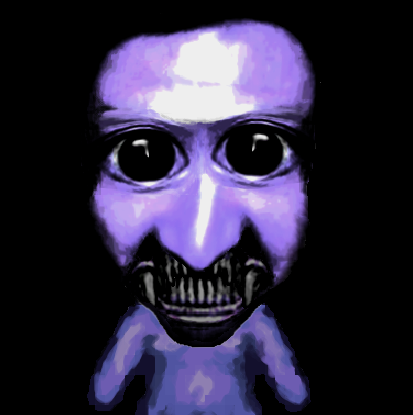
Ao Oni is a freeware indie game made with RPG Maker XP (freely available here though you must have the RPG Maker XP RTP installed to run it) that plays a lot like the original Clock Tower game. It was originally released in Japan, and has since been translated into English (albeit with a very basic translation – see further in this article). In it, you take control of a high schooler named Hiroshi who, along with three other friends, decides to explore an abandoned mansion on the outskirts of town that is said to be haunted. Your goal is to move Hiroshi through a series of 2D, top down rooms (rendered in typical 16 bit fashion) exploring the mansion and trying to find a way to escape after something traps you inside. In this sense, Ao Oni plays pretty much like a standard horror adventure/puzzle game involving gathering items, solving logic puzzles, finding clues, backtracking with keys, and all those traditional elements of games like Resident Evil and Silent Hill. However, there’s a bit more to it than that: as you make your way through the mansion, you’re constantly being stalked by the titular Ao Oni (Japanese for “purple troll”) and it’s this simple addition that, much like in the Clock Tower games, makes Ao Oni one tense game to play.

He wants you dead.

The mechanics of Ao Oni‘s antagonist are rather simple, and this is what makes him so terrifying. He appears at both random and preset points during your exploration of the game (by preset, I mean he’ll appear after you solve a puzzle or find a clue, a la Nemesis from Resident Evil 3 and by random, I mean that he can literally ambush you as you move between rooms) and proceeds to chase you around the house. You can’t fight against him, so if he catches Hiroshi, it means instant death. Thus, when he appears, you have no choice but to run away from him and try to lose him (by evading him for a specific amount of time) or by hiding in certain places around the mansion (though, in true Clock Tower fashion, not all hiding places are good ones). The Oni can appear at any time and from any direction, and often you’re given no warning as to when he’s about to come and try to eat you. This element of the game creates a lot of tension, as you find yourself jumping at any random movement, trying to anticipate the Oni’s arrival and, when he appears, the game turns into a horrifying experience. It’s that feeling of constantly being stalked that Ao Oni does so well… and turns this 2D 16-bit freeware game into a legitimately scary survival horror game.

If you’re looking for anything other than a challenge and a good scare though, Ao Oni doesn’t have much to offer. This is a game that is designed to provide the gamer with two things: scares and solid puzzle based gameplay. The story of Ao Oni isn’t something that ever takes centre stage. The reason for your character and his friends entering the mansion is never revealed, and nor are the origins of the Oni. There isn’t any attempt at characterisation or expanding on any of the characters’ personalities or motives, which makes it impossible to feel anything for any of your companions (except suspicion, when they start to bite the dust and turn into extra Onis that stalk you around the mansion). In addition, the translation from Japanese to English isn’t perfect and the game suffers from drab, boring writing and many grammatical errors. It serves to give the player just a basic idea of what is going on around them and what they need to do next, which is typically disappointing in a translated game, though can be excused in Ao Oni due to the fact that the story exists purely as something to justify the gameplay. Ao Oni is a game, not a story.

In terms of graphics and sound, Ao Oni does a competent job. Due to the fact that this is an RPG Maker game, the environments are all rendered in top down 2D sprite based graphics. They do well enough to the degree that you know what everything is meant to be and where you are, but the art style in general appears to be very minimalistic, and the mansion is nowhere near as detailed as some other RPG Maker games can be. The sound is also handled in a minimalistic way, with the only sounds you’ll hear in the game (aside from menu sound effects and doors opening) being the pouring rain outside the house and a dramatic series of chords when the Oni attacks. There isn’t anything particularly memorable or emotional (aside from the Oni’s notable theme, of course) but this isn’t a bad thing. Instead, the use of silence actually helps to emphasise the game’s feeling of isolation and helplessness, and hearing scary music suddenly play when your stalker appears has sufficient dramatic effect.

Overall, with a gameplay time of just over an hour and an extremely fair price tag (nothing), Ao Oni‘s a good game for any horror fan looking for a quick way to pass time and actually scare themselves. If you’ve played all of the latest commercial horror games (including the excellent Walking Dead), then give it a download and see if you like it – I challenge you to not be scared of that Oni.

Posted in Games | Tagged , , , , | 3 Comments

The Walking Dead: The Game [Review]

Note: This review was written when only the first two episodes of the game were available. However, the later episodes don’t really change up the game that much, so please consider my sentiments in this review to apply to the completed game as well.

###

When I set up this blog/website, I said that I’d occasionally post reviews, usually for films, books or video games that I’ve enjoyed enough to want to talk about. This week, I’ve been playing the PC version of The Walking Dead by Telltale Games, an episodic point and click adventure game with strong role playing elements based on the comic book and television series of the same name.

I’d strongly recommend giving the game a try (though it would also be wise to read to the end of this post, first) because it’s pretty unique as far as games centred around zombie-apocalypse/survival horror concepts go. Since I’ve been focusing my time more and more on my writing and university studies of late, I haven’t really had the time to play video games, and I’ve found that few, if any, modern games are able to hold my attention for a considerable amount of time these days. The Walking Dead is very different.

At its core, The Walking Dead: The Game is a (mostly) dialogue driven adventure game set in the universe of its comic-book and TV show counterparts. You experience it through the eyes of Lee, an ex-history professor convicted of murdering a senator who he discovered sleeping with his wife (though the details of the murder and whether it was premeditated or accidental are left ambiguous and up to the player to determine). While being driven to prison after your trial, you’re thrown (literally) head first into an ensuing zombie apocalypse and are given a second lease on life. You seek refuge in an abandoned house and soon meet up with Clementine, a young girl who has lost her parents. Afterwards, the two of you join a group of survivors trying to wait out the chaos, and the game’s focus shifts to the conflicts and relationships that define the group as a whole — and not everyone gets along.

Most of the gameplay consists of Lee interacting with other survivors while they go about their day to day business, and he’s often caught up in disagreements between his companions. This is what makes The Walking Dead such an amazing game to play; the characters you meet, including Lee and Clementine, are very well written and have fleshed out personalities and differing goals and motives. They often conflict with each other (and with Lee) and their disposition towards the player will change throughout the game depending on Lee’s actions and chosen responses in dialogue (much like an RPG). Before long, you’ll find yourself having to choose between certain characters to ally yourself with, as it’s impossible to be on good terms with them all.

Lee does tend to mutter to himself a lot, though.

Much like films such as 28 Days Later and the original Dawn of the Dead, Lee’s story centers heavily on morality. You’ll find yourself having to make confronting moral choices throughout the game and these decisions have real consequences. Things you say or do may come back to haunt Lee hours later into the game, as other characters remember them and react accordingly. It’s a game that really encourages you to think about your actions. As you struggle to survive, you can sink to some horrifying lows — and you can also ascend to amazing heights. I’ve always appreciated themes like these in creative works, and these aspects of The Walking Dead and how they engage the player really make it a game worth playing.

For those who care about such things, the game also boasts serviceable graphics and sound. The characters and environments in the game are all cel-shaded and the game really captures the look and feel of a comic-book, which fans of the source material it is derived from will appreciate. The locales the game visits are quite small and confined, and you don’t get to see a lot of them (this isn’t a game focused on exploration) but the key thing is that they look convincing and do the job of immersing the player enough to care about the events occurring within them. Likewise, the soundtrack is minimal but of high quality and used to great effect. The music style ranges from tense and atmospheric to emotional and reflective, establishing most of the game’s mood.

A possible issue with the game is its control scheme — it uses both the mouse and the keyboard at the same time, even though it’s essentially a point and click game. As such, it takes a bit of getting used to, and can seem very fiddly during action scenes. If you have a joypad available that is compatible with this game (it works with the Xbox 360 controller, at the very least) then you’ll definitely want to use it to play The Walking Dead. I found in the end that this didn’t detract from the positive elements of the game, but a better control scheme would’ve made it more enjoyable (if only a little).

It’s quite hard to not enjoy The Walking Dead anyway; that much is certain. It’s a breath of fresh air in both a tired genre and an increasingly stale medium that seems to lean more and more into action games like Call of Duty. The Walking Dead evokes elements of old-school adventure games and the very best RPGs.

You’ll like it. Buy it. Just make sure you bring a joypad along.

Posted in Games, Off Topic | Tagged , , , , | 6 Comments

Legionwood 2 Beta 3.0 News

Hey everyone! This is just a small update on the status of Legionwood 2, which is progressing smoothly. The next expected release will be Beta 3.0, and it will add the entire second chapter to the game, along with several small tweaks, additional polishing and bug-fixes.

Development on the game is progressing well, even though it’s been slower than I’d have liked due to being busy lately. I’m not far enough to set an exact release date yet, but I estimate that the next release should be done by August or September. Chapter Two: Aftermath and Alliance will add another four hours or so of gameplay to the game. The story sees you journeying out of Trevelle into Entoban to try and establish an alliance with the barbarians and find out who opened the Eternal Gates. There are two new towns to visit, five new dungeons, 20+ new Techs to try out and 2 new classes (Barbarian and Ranger) and a new character that you’ll be able to unlock as you go through the story in this chapter.

This chapter is also more non linear than Chapter One and will have multiple side quests to complete, as well as branching scenes and scenarios that are dependant on the moral choices you’ve been making in the game so far. You’ll be able to face one of two different bosses at the end of the chapter, depending on Lionel’s morality. Your morality will also affect which side quests you’ll be able to take on, and Chapter Two will include a side quest with two distinct versions — one will be accessible depending on what your morality is, and the other will be permanently locked off, waiting for you to play the game again with a different moral compass.

In other news, a particularly inspired Legionwood fan has begun work on a completely custom soundtrack for Legionwood 2. He’ll be composing pieces for each of the game’s main scenes, locations and battles, and, having had the chance to sample some of his early work, I can safely say that the pieces will add a lot to the game’s atmosphere. I aim to have as many of the custom tracks as possible implemented in the next Beta, but it may take a while until the entire soundtrack is in the game.

I’m also planning a new rewrite for the first Legionwood, to address lingering issues with the writing and to update the two year old script to a better standard to match Legionwood 2. Keep an eye out for that some time after the next Legionwood 2 release.

Posted in Games | Leave a comment

Your First Project

This article was originally posted over on the official RPG Maker website. It turned out to be pretty popular over there, and everyone seems to be of the consensus that it’s helpful to newbies, so I decided to reproduce it here as a blog post, so that any aspiring game developers who stumble across my site are able to heed these words of wisdom.

Listen up! You’re starting out in game development? You’re going to create the biggest, most epic indie game this side of Minecraft, you say? Give this article a read first; there’s important things you need to learn.

On First Projects

This article is intended to show new RPG Makers why a simple first project is often the best choice. In this article, I’ll try to explain the reasons why newbies should, at first, put their ambitions on hold, including:

  • A simple project is not overwhelming
  • Simple projects allow the user to play around and learn.
  • Simple projects offer no distractions for inexperienced users.

As you all most of you know, I’ve been doing this gamedev thing for quite a while now. I haven’t yet reached the elusive status of “legendary” but I’ve been around long enough that I begin to notice trends and failings in the community. In my many years in the community, I’ve seen and played uncountable projects. Some were great, some only mediocre. Some were horrible. Over time, I’ve noticed that game making trends change, so new projects eventually steal the thunder of old ones, and the community moves on. There’s one thing, however, that has remained the same ever since I first opened up RPG Maker to make my very first Final Fantasy fangame.

How many times have you seen newbies announce their epic, 20+ hour long, feature ladden, script infested first projects that they cancel shortly after? Why are first projects almost always doomed to fail? It seems that people new to gamedev are far too ambitious for their own good. I’ve done it myself, many moons ago; I’ve decided that my first project’s going to be an epic saga set to rival the cherished classics of the RPG genre. Eventually, I learned that trying to pull off an ambitious project with little or no experience under my belt has two possible outcomes: either I become overwhelmed with the sheer scale of the project, realise I don’t have the skill to do it justice, and cancel it, or else I finish it and release a bug-ridden crapfest. The moral here is that new devs must learn to recognise their limitations, and work within them until they are experienced enough to tackle a project that is truly spectacular.

The key piece of advice that anyone new to game making should heed is that to make a truly revolutionary game requires patience, skill and experience, three things that people often lack at the start of their careers. A first project should be a tool for refining these things. The ideal first project should be something simple that isn’t too hard to make. It’s important for new devs to learn the basics of their chosen engine (built from the ground up or otherwise) before they can push it to its limits. Likewise, there are fundamental aspects of game design that must be learned, such as how to create a balanced difficulty curve, how to create interesting gameplay with satisfying mechanics and how to construct an interesting, well paced storyline and likable characters.

This is a tremendous amount of things to learn, and this is why it’s often better to start off with something simple rather than that epic saga that you’ve always dreamed of making. Furthermore, it’s important for any game maker to learn how to present a game correctly, and how to read and respond to criticism, so that they can further their abilities. Taking on a simple project that has a steady rate of progress and is not too overwhelming allows newbies to have the very valuable experience of actually releasing a completed game to the public and learning to deal with feedback. You don’t need to sell your first game; even releasing something that’s free to play is a valuable experience.

You don’t always have to make a game so tremendously revolutionary that it turns the industry upside down. Even a very simple game in an already saturated genre can be a joy to play if it’s made well and clearly shows effort. Likewise, even a game done badly gives its creator an important opportunity to learn how to improve and become a better game maker. Think of it this way, new devs: would you rather release a short, simple game that’s helped you learn the nuances of game making and release that epic saga later and really do it justice, or would you like to release it now and have it fall far short of your ambitions? Heed this advice: keep it simple, keep it stupid.

Posted in Games | Tagged , , | Leave a comment

What makes a horror game?

Horror games… Like them or loathe them, they are becoming even more popular by the month, and for good reason; if done well, if actually made scary, they can become instant classics, taking the player on a journey through emotion and fear they will never forget. If done badly however, they can amount to nothing more than cheap, boring adventure fare.
Scaring someone through a video game can actually be done as effectively as in a good horror movie or book. Examples of decent horror games include Silent Hill and the more recent Amnesia: The Dark Descent. Look these up and play them! They’re scary! So, here is the question this article hopes to provide the elusive answer to: What exactly makes a horror game scary?

Spiders!

The answer is spiders. Lots of spiders. Who isn’t afraid of them?

The Original Vision

The first, most important part of making your own horror game, is to get in your head a firm idea of what you want your game to be, what atmosphere you want it to have, and how you want it to scare players (or readers, for you writer types). This is the most important question you must ask yourself: is your game going to be a shocker-cum-gore fest like Resident Evil (or most slasher films) or is it going to perhaps go for a more subtle approach, using some intrinsic psychological imagery to get under people’s skins such as in Silent Hill or maybe just try to scare people with an intense atmosphere of lurking fear such as in Fatal Frame (something more in the domain of H.P Lovecraft)?
Will the game be very straight forward in its approach, simply dropping the player into a zombie infested city, leaving them to survive, or will it deliver its horror more subtly? Will there be an emphasis on asking questions and piecing together the story and cause of the nightmare, or will the origin of the evil already be known to the player, with emphasis instead being placed on survival?
These are the questions and ideas that will determine how your game will play out. You must envision a firm idea of how you want to scare people and what feelings you want to invoke. You can’t have everything. This is why you must pinpoint the horror elements your game will rely upon early on, so that you can build your story, gameplay, puzzles and atmosphere around them.

The Story And Setting

These are perhaps the two most driving factors which will contribute to your game’s atmosphere. The golden rule of thumb is that your story must be engaging right from the outset. While in an RPG (or basically anything else that follows a traditional story structure), it is acceptable to start things off “normally”, and without incident, in horror games (or horror anything in general), you often don’t want to do this. If you do this, it can start to bore the player, which will actually decrease the amount of impact the horror elements will have when they finally do arrive. It’s important that right from the outset, the player knows they are entering unfamiliar territory, and are in danger, that just because the game has just begun does not mean they are safe. Often this is why horror games begin with little backstory, instead dropping players into the nightmare and leaving them to piece together the story themselves. This mystery, this need to know what’s going on will provide one of the main motivations to continuing. There has to be a reason that the player is experiencing these horrors. There must be something to work towards. In the game Silent Hill 2, the reason the player kept persevering with the nightmare was to finally discover once and for all what has happened to cause the situation and put the turn of events into motion.

Your story however can amount to nothing unless you have a suitably mysterious or scary setting for your game. The number one thing to remember here is that horror games never take place in a location that is entirely “normal”. There is always something a bit “odd” about the locations visited in the game that makes them seem unfamiliar and foreboding to the player and enforces the feeling of terror or uncertainty.
I’ll give you a few examples of locations used in successful horror games:

Silent Hill series – The games take place in a misty, monster infested town and many bizarre other worlds. There is something obviously “wrong” with the town and it is very far from normality. There’s a strange mystery at work and the overwhelming sense of uncertainty is what scares the player.

Resident Evil series – These games take place in more “normal” locations unlike Silent Hill, such as vast cities, old manor houses or scientific facilities. However, these locations are still far from normal. They are almost always abandoned, and in a state of chaos and disrepair, letting the player know that they aren’t safe.

Forbidden Siren/Siren series – These games take place in alternate realities, twisted versions of the real world, where nothing seems normal and almost everything seems to be evil or serve some sinister purpose.

As you can see, neither of these survival horror games take place in a “normal” environment. There is always something a bit “wrong” with the settings of the games, and there is always some sort of clue or influence that hits home the fact that the player is not in safe territory.

The Actual Scare Factor

With your story, setting and intended atmosphere/game direction decided, it’s time to start thinking of the ways in which you’re actually going to scare the player. You must try to remember to match your scare style to your intended atmosphere. if you’ve decided to take on a psychological atmosphere for example, you will not scare the player by suddenly sending ten zombies through a window. That scare tactic would seem out of place and have less effect, and would be more suited to an intense, panic survival styled game in which the player hardly has time to think as they are constantly chased by relentless monsters.

Instead, using psychological horror, you might scare the player with perhaps a flashback from the character’s past, or a piece of cryptic writing or symbolism that not only seems intimidating to read/look at, but also has a relevance in the storyline. In a psychological game, the object is to get under the player’s skin, to scare them deep down inside and leave a lasting impression. Rather than scaring them with full on gore or jumpy scares, you will load the game with seemingly meaningless things that do in reality serve some purpose. It’s all about symbolism. The object is to exploit the player’s very human psychological responses to a situation. People feel scared when they are lost or uncertain about what is going to happen. You may exploit this by making them confront seemingly unexplainable events and horrors, or by making all of your locations full of darkness and disembodied noises, creating a strong sense of uncertainty. This is also called “Lovecraftian” horror, as Lovecraft is the man most credited with inventing it, though earlier horror writers, such as Edgar Allen Poe, used this method of horror to great effect.
Meanwhile, for a gore or survival themed horror game, you would take the opposite route to your scare tactics. Here is where we use what is called panic horror or slasher horror. The object of these types of games is to make the player feel underpowered, alone and hunted. They are scared or feel tense because there’s so much pressure on them to survive in a hostile environment. The monsters are numerous and powerful, while they are alone, and health and weapons/ammo are scarce and hard to find. Safe areas are few and far between. The player is always on edge because they know they are being chased all the time, and a monster could be just outside the next door or waiting to jump through the next window. These are the types of games where “jump scares” (a scare made up of a fast moving or intimidating piece of imagery and a loud sound effect) are made the order of the day. When the player is scared that a monster may be anywhere around them, having one suddenly leap out of a closet or through a wall can really set off a great response in the player.
As you can see, pinpointing what emotions in the player you want to exploit and then thinking of ways to do so is the key to making a scary horror game. It would also not do you bad to read up a bit on psychological responses to fear so that you are aware of what tricks you can use.

Either way, the main thing to remember is to balance out the number of scares very carefully. Don’t overdo it by adding too many scares (lest the player become used to them and no longer scared) and don’t add to little either (which may cause the player to become less susceptible to the game’s atmosphere as they know nothing hardly ever happens in your game) and make sure that the scares continue all the way through the game. Don’t just put some scares in the early stages of your game to establish the atmosphere and then rely on the impact of those scares for the rest. Don’t just put them in the ending phases just to keep the atmosphere from running dry. Balance them out and distribute them evenly throughout the game. This way the player can be sure there’s always another scare coming, and this makes sure the fear doesn’t let up.

Posted in Games, Writing | Tagged , , , , | 1 Comment

Legionwood 2 Beta 2.0 now Playing

Ready for more adventuring?

As of today, the second public release of Legionwood 2 (Beta Build 2.0) is available for download. You’ll be able to experience re-balanced gameplay, polished bugs and an entire hour of whole new content taking place in the world of Westholm, extending Chapter One: Emergent Enemies to 4 – 5 hours in length, with 7 dungeons, 2 towns and 7 bosses.

And, with that… I think that’s it for now. I’ll be taking a few months off Legionwood 2 in order to work on writing my next novel (since publishers give deadlines and all) and running the literary journal that I edit. Apart from updates for bug fixes and little gameplay tweaks, you probably won’t be seeing Chapter Two for a while.

But it will come. Eventually.

Thanks for playing.

P.S You can resume playing the game using your old save file. To do this, just download the 2.0 build of Legionwood 2 and copy and paste your save files (Savexx.rvdata2) from the old directory to the new.

However, there is a small caveat: it appears VX Ace handles events after saving differently than VX. In VX, upon game load, the events present on the map will continue as they have been programmed, whereas in VX Ace, the events that were running when the game was saved will play first, even if those events no longer exist. Thus, loading a save taken at the very end of the last release will simply take you back to the title screen. You need to reload a save that was made at any time before the Brennus fight to be able to continue.

I’m aware of the bug now, and have carefully designed the end of this release to allow maximum save file compatibility.

Posted in Games | Tagged , , | Leave a comment